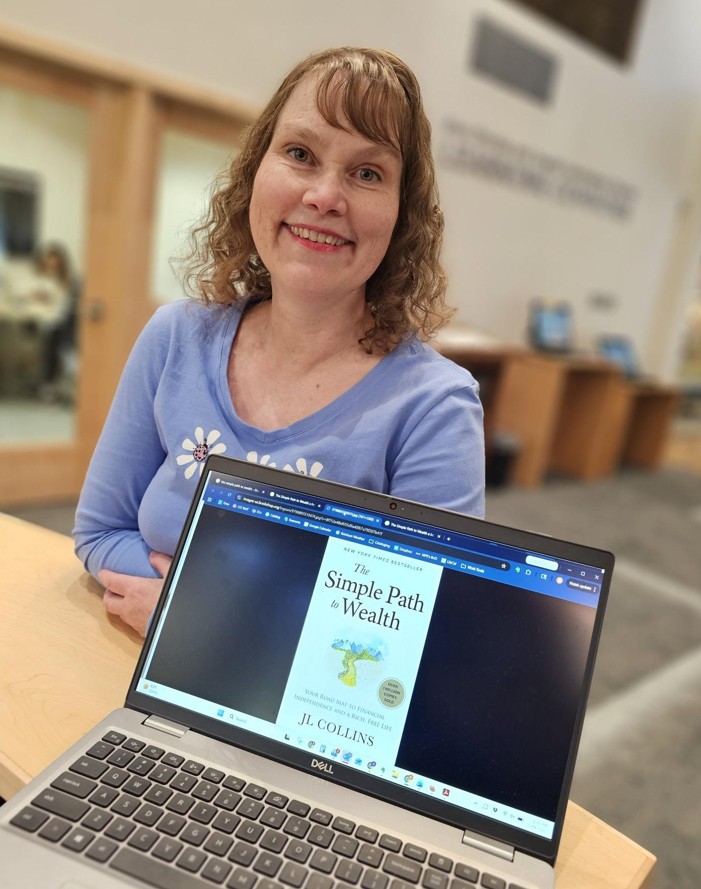
Reference Librarian Buffy McDonald recommends The Simple Path to Wealth by JL Collins.
If you are looking for a guide to help you smooth the path to financial independence, you will want to read JL Collins’ The Simple Path to Wealth. Collins wrote this book for his daughter.
He defines financial independence as having 25 times your yearly expenses. Once you reach this point, you have bought yourself the freedom to choose what you do with your time. You can continue to work and grow your assets, you can take on a quiet life, or whatever else moves you.
To accomplish this:
- Live below your means
- Invest your savings
- Stay out of debt
JL Collins stresses that people need to take living below their means seriously.
He argues that things are not as fulfilling as having the freedom to choose what you do with your time. So, he recommends trying to live on 50 percent of your income and invest the rest. If you save less, he says it will take you longer to achieve your financial independence.
Of course, saving 50 percent of your income can be something to aim for. You do not have to start there. Although, as you think about your purchases and compare them to how much you want your freedom, this may lead you to spend less just based on what you value.
It is also easier to fund a lifestyle that costs $50,000 per year vs one that costs $300,000 per year.
In terms of where to invest the money you have saved, Collins highly recommends using Vanguard because of their low-cost offerings. Within their offerings, he recommends using the total stock market index fund (VTSAX). Collins warns that investing only in stocks is aggressive and underscores how strong you will need to be. You will go through downturns for certain, sometimes incredibly wild downturns, but overall, the stock market increases with time, and this is what you are after—these long-term gains. (As you get closer to retirement, you will most likely want to add bonds (VBTLX) to help smooth the ride. Or, if you do not trust yourself to stay invested during the downturns, you will also want to add bonds.)
High interest credit card debt is the opposite of investing.
Instead of earning interest on your savings, you are paying interest to the credit card company. This is something you want to avoid. Credit card debt is having compound interest work against you. You want to move from paying credit card debt to investing so that compound interest starts working for you.
There is a lot more in this book that can help you understand how to build wealth and eventually financial independence. I highly recommend it, especially if you are just getting started saving for your future. JL Collins does a great job simplifying things that can feel quite overwhelming and intimidating.