Executive Director Jenny Emery Davidson recommends the Idaho Dyslexia Handbook.
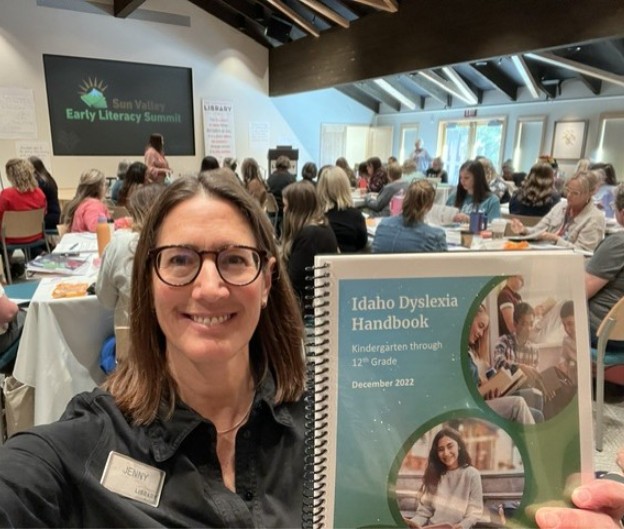
For four days last week, 118 teachers from around southern Idaho convened in The Community Library’s Lecture Hall to analyze how children learn to read.
One of the texts serving as a touchstone for the Sun Valley Early Literacy Summit, in its fifth year, has been the Idaho Dyslexia Handbook. It is a slim, taut, powerful guide to how reading happens in the brain, and how all children, including children with dyslexia, can learn to read.
In 2022, the state of Idaho passed legislation mandating training for Idaho educators on how to teach children who show the characteristics of dyslexia. Idaho was one of the last states to pass such legislation. Its handbook, though, is one of the best in the country—and its writing was led by Sun Valley local and leading literacy scholar, Louisa Moats.
All of us, I think, can benefit from understanding the amazing circuitry that happens in each of our brains to facilitate reading.
When humans invented reading, “We rearranged the very organization of our brain, which in turn expanded the ways we were able to think, which altered the intellectual evolution of our species,” writes the scholar Maryanne Wolf in Proust and the Squid: The Story and Science of the Reading Brain.
If we want every child in Idaho to be able to read, it would behoove all of us to understand – and marvel at! – how reading happens. This guide explains it, demonstrating how connections get forged between different regions of the brain, and what we can do to amplify those connections.
You can check out the Idaho Dyslexia Handbook at the Library or find it online through the Idaho State Department of Education.