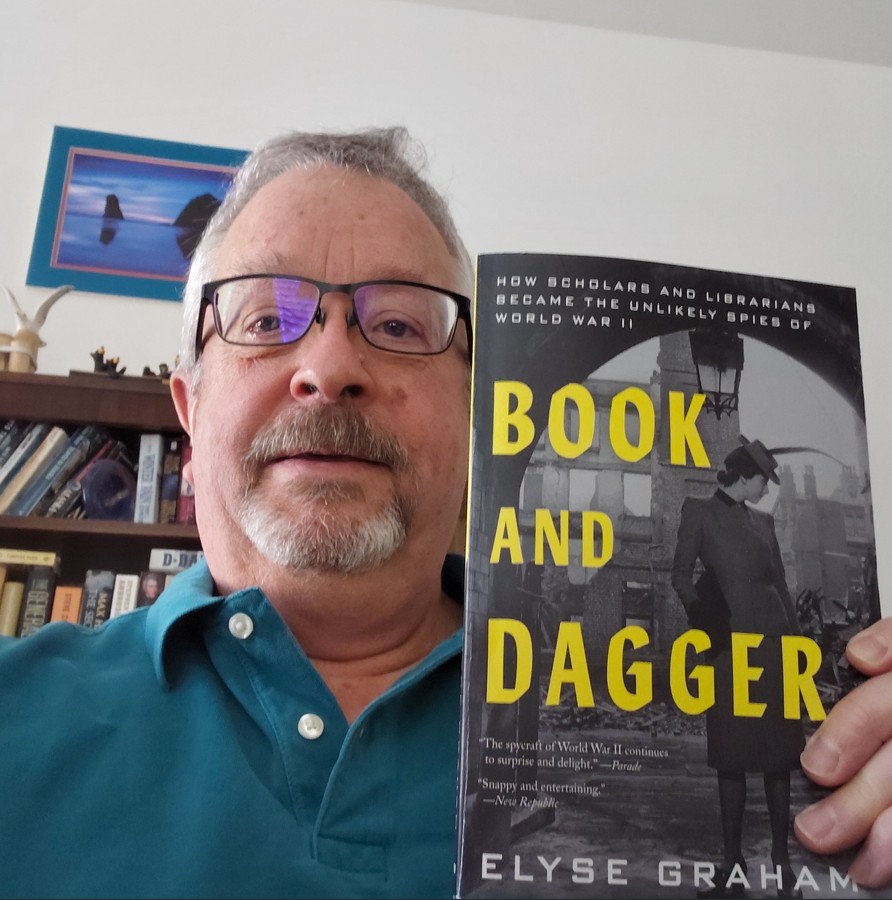
by Elyse Graham
I’ve always been interested in stories of people who worked in espionage during World War II; the French Underground being a source of many books about their exploits. I always found it fascinating that these people put their lives on the line to gather information and spy on the enemy and blow up stuff.
This book takes on that subject from a different approach. When WWII started, the United States did not have an intelligence agency, so we were way behind the rest of the world that had played the game of spycraft for centuries.
President Roosevelt created an agency called the OSS (the precursor to the CIA) and named William Donovan to head it. Donovan knew that there was no way he could catch up with other countries that had been working in the intelligence world for centuries. He started out by creating a department called the R&A (Research and Analysis) “which was something new in the world of spycraft.”
Instead of focusing on Research and Development which focused on chemistry and engineering to develop weapons and gear, this department was focused on gathering the information needed to make decisions to help our forces.
So he went to universities and other institutions and hired scholars, librarians, “number crunchers” and archivists who “had expertise in working with messy data, hunting down evidence in unsuspected places, and, above all, finding clues in the types of papers that others overlooked,” such as newspaper society columns, maps to unfamiliar cities in phone books, and potentially devastating vulnerabilities such as ball bearing production that would be used by the military.
The military was very skeptical about all this.
In one potential scenario, one of the professors would hand a general, who was scouting locations for the invasion of Africa, a telephone book. Of course the general was confused and irritated but was informed that the phone book listed the addresses of businesses that they wanted to sabotage or occupy, locations of railway equipment and munitions factories, maps of railroads and highways that they could use in the invasion, telegraph and telephone office that could alert the locals that an invasion in progress, etc.
It was very enlightening to learn that such mundane books could contain so much important information to the military, but these scholars and librarians did know this and utilized them.
The book focuses on four people from those fields and describes their journey from working in their offices and universities to spying in war-torn cities of Europe. They started out by training in the field of espionage which included cryptology, burglary and sabotage, psychological warfare, and recognizing enemy agents.
They also learned how to kill in the unlikely event they would have to face that choice in order to survive. Quite the abrupt change from their daily lives. They were sent to cities such as Paris and Copenhagen. Their cover in some instances would be as librarians looking to acquire books for their respective libraries but were there, in fact, to gather intelligence.
The United States took its greatest disadvantage – the lack of an intelligence service – and turned it into its greatest advantage. “That advantage came from innovation… The professors and librarians of the OSS were able to create something new. They became the scholars who invented modern spycraft.”
“The war may have been fought on battlefields, but it was won in libraries.”