Director of Programs and Education Martha Williams recommends The Antidote by Karen Russell.
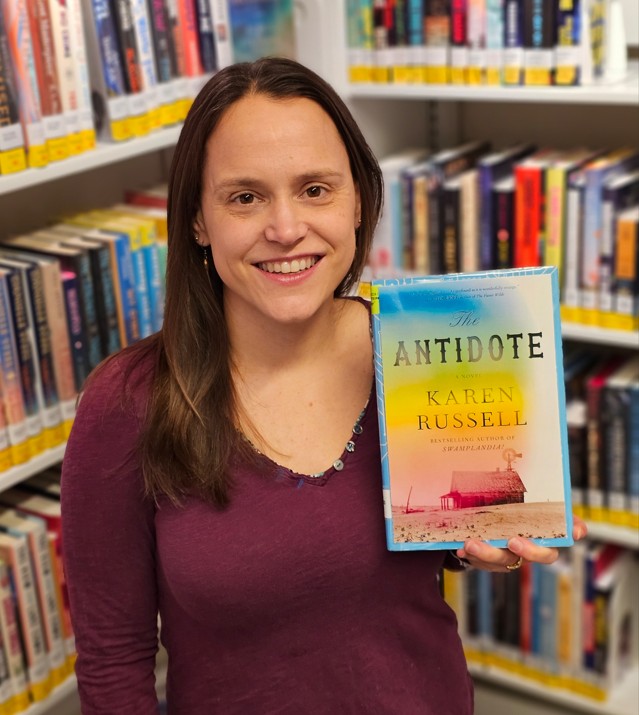
I have long been a fan of Karen Russell and her zany hyper-realism. But even if you didn’t love Swamplandia (her first novel set in a gator-wrestling theme park in the Everglades) or short stories like “St. Lucy’s Home for Girls Raised by Wolves,” where fifteen girls are painstakingly reeducated by nuns, I hope you’ll be intrigued by The Antidote—Russell’s most sweeping narrative yet.
Set during the Great Depression on the western plains of Nebraska, The Antidote follows five characters in the fictional town of Uz whose lives become intertwined in the wake of Black Sunday—a real event in 1935 that displaced hundreds of thousands of tons of topsoil from the prairie as a wall of darkness descended.
First, we meet The Antidote, a Prairie Witch who stores people’s memories for them. The people of Uz rely on her to “let the past stay in the past,” to set them free from their burdens, or perhaps to hold the dearest memories they fear forgetting. She wakes up on Black Sunday to find that her “vault” has been emptied, all the memories her customers entrusted her with gone.
We also meet Harp Oletsky, a Polish-American farmer whose land is mysteriously spared from the black blizzard’s devastation, and his hardscrabble niece, Dell, orphaned by a murder and the fearless captain of the girls’ basketball team.
Cleo Allfrey, a New Deal photographer, is sent to the area to document life and help persuade Congress to keep funding FDR’s programs. As a Black woman on the prairie with a large camera in tow, she draws plenty of attention, especially once her photographs start to reveal truths unseen.
Finally, there is The Scarecrow – an immobile figure in Harp’s field whose voice we hear every few chapters. A mysterious figure for much of the novel, The Scarecrow, like The Antidote, knows that memories are “living things.”
Framed by climate disasters, The Antidote is a timely and very American story that explores memory – both individual and our collective memory of the past – the tribulations we all face, and how what seems to divide us is nothing against the forces beyond our control.
Russell elegantly examines the stories we tell about ourselves, others, and the American West – a place long imagined as a blank slate, a place of new beginnings, but also a place of many histories buried under the soil and dust.
Find it in our collection here.
Join us for the Library’s book club discussion on April 1. Learn more about the book club here.