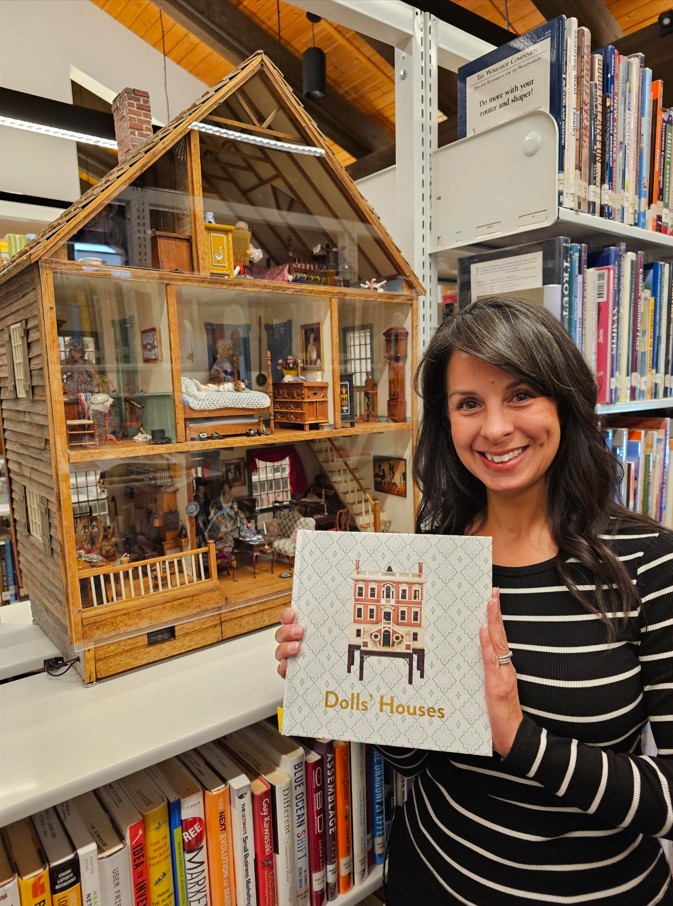
Director of Operations Yira Massey recommends Doll’s Houses by Halina Pasierbska and our collection of doll houses created by Carol Dumke.
I’ve always been fascinated with doll houses. They are so pretty, nostalgic, and whimsical. Some can be very elaborate, and it’s fascinating to look into all the rooms and be mesmerized by all the intricate little details, the thought, time, and patience it took to create them. You can instantly be transported in time to a different era.
Did you know that the earliest-known doll house was called a baby house, which meant ‘small house’ or ‘dolls’ house.’ It was made in 1557-8 for Albert V, Duke of Bavaria, and it was meant as a cabinet of wonders for his enjoyment. It was popularly known as the Munich Baby House.
The next baby house followed about 13 years later in 1610-17. It was a baby house and miniature farm commissioned for Duke Philip II of Pomerania-Stettin. As you can imagine, both doll houses were lavishly furnished.
However, early baby houses weren’t merely for pure enjoyment. They were also created to serve as a visual aid for servants and young girls who couldn’t read. The houses served as instructional aids for girls learning domestic skills in the 1600 and 1700’s.
Doll houses today continue to serve as enjoyment for their owners, and you don’t have to be a Duke to own one.
At the Library we are fortunate to have and be able to display three lovely doll houses created by Carol Dumke. Each of the doll houses will take you to a different place. You’ll find a 1776 New England Colonial house that has been beautifully and intricately furnished and even has a gentleman reading the Declaration of Independence in his chair.
A Barn dollhouse thoughtfully designed with horses, saddles, cowboy boots, barn cats, and even a loaf of Wonder Bread, a box of Ritz crackers and Apple Jacks cereal.
The Mouse House is filled with many small details, from teacups to an antique globe lamp, and even a delicious carrot cake. I encourage you to stop by the Library and take a peek at these meticulously designed doll houses, along with the book Doll’s Houses by Halina Pasierbska to learn more about the history of doll houses.