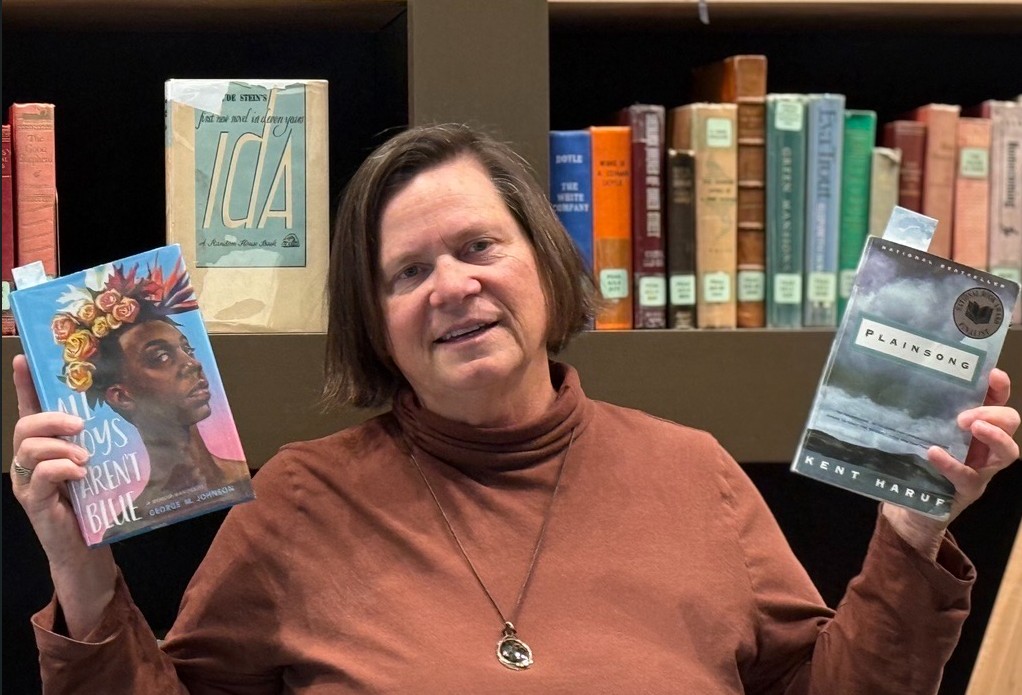
Director of Library Operations Pam Parker recommends All Boys Aren’t Blue by George M. Johnson and Plainsong by Ken Haruf.
Statistically, book challenges may have dropped in 2024 over 2023. Yet these numbers cloud another reality—thousands of titles are no longer reaching their intended audiences due to the widespread use of challenges that have opened the door to an increasing number of book bans. According to PEN America, some16,000 instances of bans have occurred in public schools and libraries since 2021. Worth noting, these targeted efforts are often focused on topics that impact young adult readers—millions of whom are effected.
Beyond the statistics, a fuller story is being told about who is being silenced and who is most impacted by book bans.
October 5-11 is Banned Books Week, an annual public awareness campaign of the American Library Association (ALA) that highlights the importance of the Freedom to Read. The principles encapsulated in this statement include the premise that censorship runs contrary to democracy. If you do only one thing this week, I suggest you read the ALA’s powerful Freedom to Read Statement.
If you can do two things, make a point of reading a book that’s been challenged or banned. I recently did just that and found myself immersed in two remarkable reads: All Boys Aren’t Blue (2020) by George M. Johnson and Plainsong by Ken Haruf (1999).
These are both coming-of-age stories that feature teen characters in tough situations as they navigate their lives. Both stories offer hopeful, enduring messages. Both explore resilience in the face of hardship and prejudice. Both include challenging material that asks us to grapple with our beliefs and assumptions. And both have been banned in the 2020s.
All Boys Aren’t Blue (2020) by George M. Johnson is written by a queer-identified author who uses they/them pronouns. This “memoir-manifesto” is a first-person account of Johnson’s youth in Plainfield, New Jersey. These letters and essays include topics such as Black family dynamics and traditions, negotiating playground dynamics as an effeminate boy, going to your Senior prom with your best friend, and not feeling comfortable in sharing your innermost feelings with beloved family members.
Yes, it’s about being a teenager and finding your place in the world.
One of the most endearing aspects of the story is George’s relationship with their grandmother, “Nanny.” Her self-described ‘hustle’ is an important influence on young George. One of her favorite sayings is, “Charity begins at home.” She teaches her four grandsons to treat each with love and acceptance. In high school, Nanny helps George to open a soup kitchen at a local church to fulfill his school’s volunteer requirements. Later, when she falls ill, they are her caregiver. In a second memoir, We Are Not Broken ( 2021), Johnson’s pays tribute to her influence and memory – and explores how Nanny boosted their confidence from shy boy to capable adult.
Two chapters in All Boys Aren’t Blue grapple with sexuality. One is about a life event at 13 involving an older cousin who introduces George to sex before it’s appropriate or they can fully understand the dynamic. The other is at 21 when they learn about consent and begin to accept their identity. Throughout this work, the concepts of agency over one’s body, attire, name, and opinions are explored.
Banned in eight states–and 29 school districts–All Boys Aren’t Blue has become the most challenged book of 2024. Johnson, 40, remains active in advocacy for youth access to stories like theirs and continues to work as an author and journalist.
For comparison’s sake, I also read a novel impacted by the recent wave of book bans, Plainsong by Ken Haruf. Published over 25 years ago, the novel jettisoned that aging author out of obscurity. Haruf, the son of a Methodist minister, held a series of odd jobs in towns not unlike the fictionalized Holt, Colorado, where the novel is set. These influences led him to explore themes of poverty, morality, and community.
The story is a moving account of life in an economically depressed small town during the 1980s. Haruf’s portrayals, while sympathetic, also point us to the need for resilience in the face of necessity. The hardships faced by his characters demand that we ask ourselves what we might do – and what it means to do the right thing.
The characters are ordinary people, like Tom Guthrie, a high-school teacher and the father of two boys, Ike and Bobby. The family copes with his wife’s depression, which ends in her going away to Denver to live with a sister. The two boys deliver newspapers in the small town. While collecting fees, they meet a dying elderly woman who shows them kindness and sympathy, and how to bake cookies – and, they start to drop in to check on her. We also are introduced to Victoria Roubideaux, a teenager who becomes pregnant during her senior year. She is locked out by her mother, literally. She finds a temporary place to sleep with a sympathetic school employee who helps her find her prenatal care and refuge on a ranch where two aging brothers offer a spare room while she navigates the pregnancy.
Plainsong is a novel about the importance of interconnectedness through community. Haruf seems to be asking us to consider our moral obligations to each other.
In Plainsong, the author renders a moving account of relatable characters facing real-life situations, like divorce, death, pregnancy, and mental illness. Still the novel has been recently listed by the Florida Department of Education as a book not appropriate for K-12 students. In short, it has joined the increasingly long list of challenged and banned books in schools across the country. It is the brief passages describing the girl’s experience in becoming pregnant that are deemed grounds for the ban. The list of nearly 700 titles includes works by John Grisham, Margaret Atwood, and Nicholas Sparks, to name a few of the authors banned in Florida schools in 2024.
Ken Haruf hardly seems the sort of author to be challenged or banned. He won the nomination for the National Book Award for Plainsong, and he would go on to make a trilogy based in Holt, Colorado. The work was adapted to a Hallmark TV movie in 2004. Over the years, the novel has been studied in high-school classrooms – and it is considered a significant work of modern American literature. He died in 2014, just two years after being award the Wallace Stegner Award – a distinction that honors those making a sustained contribution to the cultural identity of the West.
The banning of stories like All Boys Aren’t Blue and Plainsong begs us to ask: “Who are we protecting and from what?”
Banned Books Week (October 5-11, 2025) and Take Action for Libraries Day (Saturday, October 11) are times to ask ourselves questions about book bans and their impacts. Search for #UniteAgainstBookBans to learn more.